Showing posts with label Economy. Show all posts

Monday, 26 September 2016

11 posers for Osinbajo

By Bolanle Bolawole
“…It is important for us to understand the nature of this recession in which we have found ourselves…If we did not have the vandalism in the Niger Delta as we are currently suffering, we will not have this recession today” – Vice President Yemi Osinbajo.

As the economic crisis bites harder and the recession deepens, it has become necessary to interrogate previously held truths and ask unpalatable questions that may unearth issues that the powers-that-be would rather securely keep under wraps. We do ourselves grievous harm if we look at their faces or consider how they feel or react when we hold their feet to the fire. We the ordinary people suffer the perilous times more than the leaders; if they suffer it at all! They hear about it and talk about it but it is not more than mere statistics to them because they don’t feel it in the real sense of the word.
We are the ones wearing the shoe; they glide about in their presidential and private jets and bullet-proof, state-of-the-art limousines fuelled and maintained at whopping costs at public expense. They are more than adequately protected from the vagaries and vicissitudes of economic depression. Their needs and wants that money can buy are met at public expense. They don’t wake up thinking about the basic needs of man – food, clothing, and shelter. They don’t go to bed worrying about where their next meal will come from. Their children go to the best schools; they and their family enjoy the best facilities everywhere. They are called public servants but Nigeria serves them instead!
The Constitution of the Federal Republic of Nigeria appears to recognise the Vice President as a very important public servant on economic matters. He shall be Chairman of the National Economic Council, which shall also consist of the state governors and governor of the Central Bank of Nigeria. As important as his position is, we must note that the VP does not have the last say since the National Economic Council that he chairs only “have power to advise the President concerning the economic affairs of the Federation…” Stripped of all adornments, the VP is nothing more than a glorified adviser on economic affairs to the President.
Taking a cue from ex-President Olusegun Obasanjo, the President is not even obligated to accept his VP’s advice. On the surface, it would appear as if Osinbajo is being allowed by President Muhammadu Buhari to handle the economy but grapevine sources dish out misgivings. While too much secrecy surrounds government, there is no smoke without a fire. Intrigues and power-play, as much as incompetence and inefficiency, have been the grave yards of many governments. Based upon the foregoing, I have 11 questions for Osinbajo. I expect him to forthrightly address them – or he should forever hold his peace!
One: Does he actually preside over the National Economic Council as enshrined in the Constitution? Two: Does he perform his constitutionally assigned role of an economic adviser to the President without let or hindrance? Three: Has he offered the President advice on the economic depression? Four: How will he describe the President’s attitude to the advice he gives – excellent; satisfactory; not-too-satisfactory; poor; very poor? Five: Does he have unfettered access to the President? Six: Does he have the ears of the President? Seven: As the Number Two Citizen, is his position and person accorded the expected respect and deference by official and unofficial sources around the President? Eight: How is he carried along on important Government decisions: All the time; some of the time; once in a while; rarely; not at all? Nine: Is he aware that strident criticisms of the performance of the economy are direct or indirect indictment of his capabilities and competencies? Ten: Is he aware that his performance in this government will rub off positively or negatively on the geo-political zone where he comes from?
If we know our leaders too well, we may never get a public answer to these questions; and if at all, it could be what is safe and proper to say in public. But, again, there is no smoke without a fire. As much as our leaders may try, a lot of information they wish were suppressed would still escape into the public domain. For instance, we know that the intransigence of the President on devaluation of the Naira left the issue unresolved for too long until the currency had suffered irreversible losses. When, eventually, he succumbed, the quantum of devaluation needed had become appalling. This was like the case of the proverbial sick person in Yoruba folklore who was required to simply say to, to get healed but insisted he would not say to to to. He ended up paying thrice the price! Who are the unofficial economic advisers who have erected themselves between the President and those constitutionally assigned the responsibility? They should come into the open so we can know them and hold them accountable, instead of pillorying the wrong people.
We would also like to examine their economic blueprints and subject same to public scrutiny. The President and his unofficial economic advisers will also do the country a world of good if they sit in the meetings of this administration’s economic team, contribute to arguments and be mindful of how decisions are arrived it. It makes little sense to stand aloof, unmindful of the efforts that produced a decision, only to whimsically toss it out of the window. Much time is wasted this way before decisions are reached. The officials assigned the duty of managing the economy keep going back and forth with very little to show for their efforts. They are presented as incompetent when this, actually, may not have been the case. They soon get exasperated and discouraged. They soon get unsure, unsteady, and uncertain in their steps.
By the way, is there an Economic Team? Who are the members? The President has left the country guessing. So, our guess has been that the VP, CBN Governor, Ministers of Finance and Budget Planning; possibly the DG, Debt Management Office; and a few other Presidency officials and Special Advisers and or Assistants constitute the official Economic Team. No one should expect that state governors would have the time to commit full blast to the National Economic Council; neither should we expect Ministers, DGs and others who have other statutory assignments to take care of. So, the team is amorphous as it is. The job appears to be everyone’s job which ends up being no one’s job. Has it been deliberately structured this way so it may fail? Is this a ploy to make for the continued relevance of influence peddlers and unofficial economic advisers around the President? Is it also true what we hear that this government is opposed to a bi-partisan approach to tackling “this depression”?
And that it must be the duty of the APC-led government alone so that the impression is not created that they are not on top of the problem? That under no condition should be independent-minded persons be allowed to meddle in what is now seen as purely the “family affairs” of APC? I dare to say that, this way, we can only sink deeper in the miry clay. All promises that we will exit depression by the fourth quarter of this year will, in the end, turn mere cold comfort. When we are dangerously close to the timelines set for depression exit (DEPREXIT) and nothing is happening, they will shift the goal post! We have suffered that again and again in this country. Can the VP please name those working with him on the economy? We need to know so we can examine their credentials – and also hold them accountable. Proffered solutions must be openly traded before they become policies. There is too much monkey business about the way the economy is being handled at the moment.
All hands must be on the deck for us to exit depression. Government policies must be clearly discernible and consistent; not ‘ban this today, unban it tomorrow, ban it again the next day’ ad nauseam. Fiscal and monetary policies must align and reinforce one another and not work at cross-purposes. The CBN appears too fussy about protecting its assumed turf while government is too flustered to mount a challenge. The three tiers of government must work as congruent; everyone for himself and God for us all will move us nowhere near DEPREXIT soon. At no other time since the Civil War has this country been this divisive as well as frustrated with the leadership. The Buhari Presidency has neither been the rallying point nationwide that it ought to be nor has it provided the effective leadership that the times demand. My final question to Osinbajo: This government, if it got nothing positive at all from previous governments as it has shouted from rooftops, got a peaceful or quietened Niger Delta handed over to it; who frittered that peace?
The late President Umaru Yar’Adua, a deep and thoughtful thinker, no doubt, assiduously cobbled together peace in a region whose restiveness had blighted previous military and civilian administrations – but within weeks of coming into office, this administration squandered that peace and brought back Niger Delta militancy, which in turn has brought “this depression” (Osinbajo’s words quoted above). If renewed Niger Delta militancy is what has brought “this depression”, then, the APC\Buhari administration is to be held responsible for on-going unimaginable and unpardonable suffering of Nigerians.
What we lose in revenue in just one day as a result: “over one million barrels of crude oil on a daily basis” (again, Osinbajo’s words) multiplied by the cost of crude oil per barrel on the international market is more than all the advertised cash\property recovered by the anti-corruption agencies plus the garrulous posturing and international junketing of this administration in search of elusive FDI. Kobo wise, Naira foolish! Whereas I pity Osinbajo – suddenly, he is grey hair all over and looks older than his actual age – it gets easier by the day to scapegoat and sacrifice him on account of his perceived but orchestrated (mis)handling of the economy.
-turnpot@gmail.com 0705 263 1058

Friday, 26 February 2016

Buhari And The Solution To The Nigerian Currency Quagmire 
By Femi Pedro


Our nation is currently submerged in a currency crisis. The value of our national currency is tumbling against the dollar on a daily basis, and our foreign exchange reserves continue to dwindle as a result of the continuous fall in the price of crude oil. In recent months, there has been a rigorous debate as to whether the devaluation of our currency is the answer to these problems, and what specific measures need to be put in place to stabilize our currency and prevent further damage to our fragile economy. As the debate rages on, the damage to the naira, the economy, and the psyche of our people has intensified. The Central Bank of Nigeria (CBN) appears to have lost significant control of the situation, and speculators, currency traffickers and perpetrators of arbitrage have seized the initiative in the parallel market. 
President Muhammadu Buhari speaking in Paris
It is fair to say that under President Muhammadu Buhari’s tenure, the Nigerian Financial Sector has endured its reasonable share of activity and critical scrutiny. Four major incidents have stood out, and these incidents are intertwined in terms of the collective impact they have all had on the sustained call to devalue the Naira. First, in the past year alone (dating back to the previous administration), the Central Bank of Nigeria (CBN) has reeled out a series of policy reforms on the foreign exchange market that has sent panic to the market. Leading up to the general elections conducted last year, the market began to experience a significant shortage of dollars. This dwindling of our reserves was caused by falling oil prices, while the huge demand was fuelled by election spending and the accompanying market nervousness about the possible change of government. The CBN’s response to these events further exacerbated the situation, and this has driven the parallel market rates to the roof. Secondly, the Federal Government issued a directive on the consolidation of Government revenues into a single treasury account (TSA), a bold policy currently being implemented at its infancy stages by the CBN. The immediate effect of this policy has been the estimated movement of over N2 trillion from private banks to the CBN, which has dipped liquidity and spiked interbank and other interest rates. Thirdly, and probably as a result of the first two points, we received the curious news sometime in 2015 that JP Morgan Chase-an American-based International Financial Service Firm- would be delisting Nigeria from its Government Bond Index for Emerging Markets (GBI-EM) in what they called “a phased-out process” between September and October this year. JP Morgan cited a lack of transparency and liquidity in our foreign exchange market as the primary reason for its decision. The significance of this announcement cannot be understated, because JP Morgan Chase provides the pricing and trading platform for foreign investors who hold or are planning to hold Nigerian Government-issued bonds, and they also create and sustain an active market for these bonds. Finally, and most problematically, has been the dramatic slump in the price of crude oil, which in turn has had an adverse effect on our dwindling reserves. 
These major action points, alongside some of the uncertainties that have arisen as the Federal Government grapples with how to articulate its holistic fiscal policy and medium-term Economic framework, have created deep-rooted cracks on the naira exchange rate. The cumulative effect has been the sustained pressure (both locally and internationally) carefully mounted on the CBN to devalue the naira to reflect its ‘true’ value at the parallel market. The pressure is on the government to remove its hold on the official rate by moving the rate closer to the parallel market rate, with the expectation that a higher official rate would price the scarce foreign exchange appropriately and attract players back to the official market, thereby improving supply and increasing market stability. If historical antecedents are anything to go by, this devaluation proposition is unlikely to have the desired effect. 
Those who fail to learn from history are doomed to repeat it, so in our attempt to adopting bold, decisive and creative solutions to stop the economic bleeding, we must properly educate ourselves on our current situation, and how we got here in the first place. It is a situation that has played itself out in countries like Brazil, Argentina, Greece and Venezuela. Some of these countries survived their currency quagmire by taking bold, decisive and creative steps to limit the damage to their economy and return their currency back to normalcy. In actual fact, this is not a situation that is completely unfamiliar to us. 
The current foreign exchange regime is an off-shoot of the last major reforms between 1995 and 1999. The supply of foreign exchange has been dwindling since the price of crude oil started its free-fall in 2015, whilst foreign exchange demand has been on the rise due to market confusion, its negative perception of future supply, recent CBN measures to manage demand and an overall loss of confidence in the market by foreign investors and speculative dealers in foreign exchange. Indeed, the structural impediments or the 90s are still intact today. Rather than removing the bureaucratic bottlenecks in the system, successive CBN administrations have been focusing on defending the naira by tinkering with the pricing mechanism, while letting illegal operators take the initiative. The result of this is the existence of a two-tier market - the legal (official) market, and the illegal (parallel) market. 
The official market comprises of the CBN as the main supplier, and banks, oil companies, non-oil exporters, Bureau de Change (BDC) licensed operators and legitimate end-users who deal in the inter-bank and autonomous trading window within the banking system. The CBN has kept a lid on the rate in this market at around 199 naira to a dollar. This is the only legal foreign exchange market supported by existing laws. The parallel market comprises of a collection of players including speculators, currency traders, street currency hawkers, tourists, travellers, traders, small and medium sized businesses (SMEs) and migrants from the official market attracted by the huge differentials in the rates for arbitrage opportunities, and the ease and simplicity of the market. The problem has been further compounded by the CBN’s conscious and deliberate position to ignore the parallel market’s existence by pretending that there is only one exchange rate. Its stubbornness has driven buyers and sellers to the parallel market, making the official market more unstable. 
Of course, the primary objective has always been the efficient management of the foreign exchange market by determining the true price of foreign currency vis-a-vis the naira. The reality is that nobody- including the CBN- knows the true value of the naira. The value of a currency is its price, just like price determines the value of goods and services. The Naira-Dollar ‘product’ is like any other good; its price is determined by a complex interplay of demand and supply, which forms the price at equilibrium. The real conundrum is this: who knows the actual demand and supply? Of course, the CBN knows how much dollars are available for sale on a weekly basis, and how much naira is utilized to meet the demand for the dollar. The information that the CBN possesses comes from its position as the major supplier of both currencies, and its main function as the banker to our banks and the custodian of the foreign exchange market. In truth however, nobody has the authentic information on the actual volumes of Naira and Dollars chasing each other in our economy. 
To make matters more complicated, this is only a segment of the market. For example, the official exchange rate is pegged at approximately N199 to $1 because it is based on CBN’s information on the official demand and supply, which is supposed to be the equilibrium price. Unfortunately, the mechanism for arriving at this rate is largely discretionary, unscientific and questionable. The CBN may have been right in arriving at this rate, but it very well may have been wrong in arriving at this rate as well. The parallel market rate is hovering between N250 and N400-$1 today because the market gets some of its supply from the CBN and will naturally add profit to resell. It is selling mostly cash, which always sells at a premium. Cash has a monopoly because the traders in this market have perfected the art of rigging rates. All these aggregately ensure that the parallel market rates will forever be ahead of the official rates. It is therefore wrong to use the parallel market rate as a reference point because it is not quite determined by any traceable interplay of demand and supply. The rate is rigged and illegal, and should be ignored in its entirety. 
It is therefore not unlikely that the parallel market might be bigger and more active than the official CBN market. Nobody knows the exact volume of dollars being traded in this unofficial market, or the naira-cash floating outside the banking system that is being used to buy and sell dollars. We do not have accurate estimates on the number of mallams, or the total volume being traded by them daily. We do not know the exact volume being traded by unregistered foreign exchange dealers all over the country. We also do not know the exact amount of raw cash dollars imported and exported by Nigerians and foreigners. So, how then can you determine the equilibrium price of a market with so many unknowns! 
President Buhari is correct in believing that our currency does not need to be devalued – for the time being. For example, no amount of devaluation will bring up the price of oil. Indeed, devaluation will not eliminate parallel market players, nor will it necessarily increase the supply of dollars into the market. In actual fact, devaluation will simply push the official rate (and by extension, the parallel rate) up, thereby compounding the currency crisis and further driving more players to the parallel market. Inflation will rise, impacting the cost of essential products and services within our economy. 
The sum-total of the aforementioned points is that it is unhelpful to conclude that our naira is should be devalued because we simply do not have any rational indices for measuring the naira’s true value. A further devaluation will devastate our economy because it will technically make our imports more expensive and our exports cheaper. Of course, this is somewhat unhelpful to us because we import practically everything and export very little except oil, whose price is determined internationally, and our supply also quota-based. Therefore, the gains of devaluation would be inapplicable to our situation, while the adverse effects- higher import prices, higher rate of inflation, more pressure on the demand for dollar, higher unemployment and general recession- would be catastrophic to us. 
Perhaps, a silver lining in all of this can be adduced from our recent experience with petroleum importation, pricing and marketing. The introduction of the subsidy regime by the Obasanjo administration around 2005, while commendable in its intent to maintain a low pump price on our imported petroleum products, turned out to be a catastrophic and costly error on the part of the previous administrations that retained it. The subsidy-era was marred by market instability, regular fuel shortages, a thriving black market for fuel and huge debts allegedly owed to importers. Now that the subsidy regime is virtually non-existent, the market has gradually become stable, and many of the associated problems have disappeared. First, there is only one recognized market price (at the filling stations) across the country. Secondly, there no longer exists a thriving parallel market for petrol; there simply is no need for one, as there is no scarcity or bottleneck in the supply chain for now. Thirdly, suppliers are motivated to supply because the pump price has been determined by factoring all possible costs and profit margin from point of purchase to point of sale. Finally, this system will always adjust the pump price mechanically, thereby guaranteeing regular supply at all times. The end result is that consumers are invariably assured that supply will be regular and price would continue to be market-determined. There is no guarantee that this current solution will be permanent, but it is at least a marked improvement from the previous uncertainty. A replication of this way of thinking by the CBN will go a long way towards returning normalcy to our currency market. 
What then is the way forward with our currency? First, the Federal Government has to fast-track its efforts towards implementing a sustainable fiscal policy regime tailored towards boosting our local industry. Curbing corruption, promoting import substitution and the exportation of indigenous products will go a long way in achieving this aim. Many other countries like India, South Africa, Malaysia, Indonesia, Egypt etc have little or no oil dollars, but they all have more stable currencies and stronger liquidity than we currently do. They have been able to successfully tap into these “other sources” and develop a stable foreign exchange system with a thriving market to boost supply and manage demand. 
Secondly, a critical solution lies in our ability to bring sanity to our foreign exchange system and have better controls over the demand and supply mechanism. As a matter of national emergency, the parallel market has to be destroyed. The Foreign Exchange (Monitoring & Miscellaneous Provisions) act of 1995 as amended, the Money Laundering (Prohibition) Act of 2011 and other Laws of the Federation are some of the legal tools available to enforce the collapse of the parallel market. 
The CBN has to overhaul the foreign exchange regime by bringing all legitimate buyers and sellers into the official market. For example, the use of credit cards to make purchases online and in foreign currencies should be re-introduced, with each authorized dealer setting its own limit depending on capacity. The way to do this is to simplify the buying and selling process by making documentation easy and seamless, and accommodate all economic users of foreign exchange. The buying and selling process could be simplified through the authorized dealers with clear and unambiguous rules, while CBN provides adequate supply to the market at all times. 
Finally, and perhaps most crucially, the CBN must create a buyer surcharge and seller premium system. It should be noted that the CBN is not the only supplier to the market. Other suppliers include oil firms, exporting firms, Nigerians in diaspora, foreign investors, foreign lenders, etc. These suppliers could provide a much higher volume to the market than the CBN if motivated and encouraged. Under this system, buyers of foreign exchange for products and services categorised as essential or critical to the economy would be sold foreign exchange at the official buying rate. Rather than impose restrictions and/or bans on other users of foreign exchange outside the essential list, the foreign exchange could be sold to non-essential categories at the same official buying rate (a single exchange rate system) but with an additional surcharge imposed for accessing foreign exchange. The surcharge could either be flat, or could fluctuate depending on the nature of the product/service being imported. This will be paid upfront at the point of purchase to the coffers of government. It can be categorized as a special tax for users of foreign exchange for purposes considered as non-essential or non-contributory to the progress of the economy. This special tax becomes a premium to government. It will be an immediate boost to the national revenue, and the Government may choose to utilize this fund to promote and boost the non-oil export sector. It will also make these products and services more expensive, and possibly have the long term effect of discouraging the importation of non-essential items. Simultaneously, suppliers of foreign exchange to the market can be incentivized into selling at the official selling rate, while also earning an "incentive premium". For example, an incentive premium of 10% could be paid from the surcharge proceeds to encourage and motivate suppliers to bring their foreign exchange to the official market. This system of surcharge and premium could be sustained until the market stabilizes. The CBN would simply midwife the process by maintaining and aggregating adequate supply into the market as much as possible. It would also be responsible for posting the official daily buying and selling rates based on market fundamentals, managing the surcharge and premium regime, and determining the categorisation of essential users on a periodic basis. It should also put in place a regular audit and monitoring process to ensure strict compliance and adherence. 
The immediate effect of effectively implementing the above recommendations will be a single official foreign exchange market with all players (buyers, sellers, dealers, government) adhering to the same set of rules and regulations. The parallel market would die a natural death, and there will be an efficient pricing mechanism with a single exchange rate. This in turn will lead to an effective and efficient management of our foreign exchange reserves, and will enhance the attraction of foreign exchange into the system from other sources. Putting the tax and incentive mechanism in place will have the combined effect of encouraging supply and penalizing the frivolous use of our scarce foreign exchange. This also creates a new source of revenue for the Government, and acts as a check on those who would normally cheat on import-duty payments. The economic impact will be appreciation or depreciation, but not a devaluation of the value of the naira. There will be market and price stability, gradual confidence restored back to the single market and demand and supply equilibrium. 
It would become easier for the Federal Government to deploy its security apparatus and other legal instruments towards chasing away the remnant players in the illegal market when the CBN successfully brings the legal buyers and sellers into the official market. With regards to the parallel market operators, the Government should apply the same vigor that it is adopting in its pursuit of corrupt officials, because every effort to manage our foreign exchange market will simply be like pouring water into a woven basket until the parallel market is eliminated or reduced to insignificance. 
These issues have been with us for over 35 years. They are not going away until we take a firm stand to render the underground foreign exchange market insignificant and irrelevant. Only then can we start focusing on addressing the actual value of our currency against the dollar and other currencies. In the interim, any attempt to devalue the currency amounts to treating an ailment without a proper diagnosis. 

Otunba Femi Pedro is a Banker and an Economist. He is a former Deputy Governor of Lagos State, and the former Managing Director of First Atlantic Bank (FinBank) Plc. He can be reached via the Twitter Handle: @femipedro
Source: http://saharareporters.com/2016/02/26/buhari-and-solution-nigerian-currency-quagmire-%E2%80%A8by-femi-pedro

Wednesday, 24 February 2016

Who is killing the Naira?

AbdulSamad Isyaku Rabiu, Executive Chairman of BUA Group (Dangote's main business rival), took an unusual step of writing a full page article in Business Day of Monday, 22 Feb 2016 claiming that the current naira free-fall is caused by a few greedy people, or more to the point, a particular person.

BUA Group is into the business of manufacturing of cement, sugar refinery, flour, edible oils, pasta and rice cultivation.

Abdulsamad Isyaku Rabiu: 
Whilst the federal government is doing everything to protect the Naira, there are Nigerians – corporates and individuals alike who are grossly undermining the government’s position – sometimes with the aid of regulators – knowingly or unknowingly.
Whilst some manufacturers are experiencing extreme difficulty sourcing foreign exchange for legitimate business operations within Nigeria, others are getting forex to set up operations in other countries. 

It is rather ironic that a similar competitor in the same industry, who incidentally is the market leader, is allocated huge amounts of Nigeria’s hard earned and scarce forex from the official market for its operations in Congo. I do not know if there is an official policy to that effect but I was baffled, as were numerous Nigerians, to learn through a publication of forex allocation returns by First Bank of Nigeria Limited in THISDAY Newspaper of Tuesday, February 16, 2016 (page 11) of that allocation, whilst other operators in the same industry have received far less or nothing at all during the same period for verifiable and viable investments within Nigeria.

t begs the question, “Were other plants by that operator across Africa built with Nigeria’s money?” How has that impacted the country’s economy in return? If this is true, then it needs to be checked, as we cannot have a situation where Nigerian industries are being shut down, workers are losing jobs daily and resources badly needed to develop our economy are being taken out of the country to grow other economies to the detriment of ours. If this transaction was done using “Form A” like the publication suggested, then it is just money that has gone out from the country, which can be rerouted into the country for larger profits. 

Without doubt, there are many persons and corporate entities who are aware of the goings-on in the Nigerian forex market but are afraid to speak out because of the perception that those involved are too powerful but if no one brings these issues to the fore, there is absolutely no way we can progress

: http://www.osundefender.org/manufacturing-the-fx-situation-and-the-nigerian-economy-by-abdulsamad-rabiu/


Few days ago Dr Ifeanyi Ubah, CEO of Capital Oil took a rather unusual step of appearing on Channels TV on Sunday, 21/2/2016 to make a very bold claim that the current Naira slide is artificial, and is caused by a few individuals. He said that he "knows those behind the current foreign exchange crisis facing the nation and was ready to name them publicly". 

He also staked his entire assets of N500b on his claim that he will expose the saboteurs, reverse the slide in 30 days and bring Naira back to 1$=N200. FG is yet to take up the offer. However, since these two 

http://www.vanguardngr.com/2016/02/i-ll-name-those-behind-forex-crisis-if-says-ubah/

http://www.authorityngr.com/2016/02/N200-PER-DOLLAR-PROPOSAL--Ifeanyi-Ubah-stakes-N500bn-assets/

Abdulsamad Rabiu spoke on Sunday, 21/2/16. The very next day, Ifeanyi Ubah spoke in same vein on Monday, 22/2/16. 
Are these mere coincidences? is anybody thinking what I am thinking? Is anybody in Buhari's govt and economic team getting the message?

Both Abdulsamad Rabiu and Ifeanyi Ubah are seriously supporting Federal Govt policy not to devalue the Naira, whilst a powerful business men are secretly nudging FG to agree with IMF and devalue the Naira. Why? Who is benefiting from all these mess?

More importantly, which powerful individual or corporate entities are Abdulsamad Rabiu and Ifeanyi Ubah referring to, and even threatening to name? Nigerians wake up and shine your eyes oooooo!!   

Meanwhile, in previous news, in January 2016 CBN Gov Emefiele visited Dangote's new refinery/petrochemical/fertilizer construction site at Lekki free trade zone and pledged that FGN will supply him all the dollars he needs for this private project at official rate of $1:N197, which is currently estimated at $10 billion. This represents 30% of our reserves. 

Wednesday, 20 January 2016

By made in Nigeria


HERE COMES THE JOB MADE IN NIGERIA.                                                                  John Sadiq started the day early, having set his alarm clock(MADE IN FINLAND) for 6am. While his teapot(MADE IN CHINA) was perking, he shaved with his clipper(MADE IN HONG KONG). He put on his shirt(MADE IN THE UK), and designer jeans(MADE IN ITALY) and shoes(MADE IN THE USA). After cooking his breakfast in his new electric cooker(MADE IN INDIA) he sat down with his calculator(MADE IN MEXICO) to see how much he could spend today. After setting his watch(MADE IN TAIWAN) to his radio(MADE IN VIETNAM) he got in his car(MADE IN GERMANY) filled with petrol imported from (SAUDI ARABIA) and continued his search for a good paying NIGERIAN job.
At the end of yet another discouraging and fruitless day checking his computer(MADE IN MALAYSIA), John Sadiq decided to relax for a while. He put on his slippers(MADE IN BRAZIL) poured himself a glass of wine(MADE IN SOUTH AFRICA), while fiddling with his mobile phone(MADE IN SOUTH KOREA), and then wondered why he cant find a good paying job in... NIGERIA  
Fellow Nigerians, lets us start producing, let us start buying made in NIGERIA goods. If our economy is to grow and better jobs created, we must cease from being an economy that is all about consuming(Importing), and become more of a producing(Exporting) economy.
We must also change our mind set from over-patronizing foreign products to the detriment of our own local brands. Let's go back to the land to grow and patronise made in Nigeria products. Let's stop insatiable appetites for foreign foods and products.
# Producenaija
# Buynaija
Please share, spread the message. Lets build a strong economy for ourselves and our generations to come.

Posted by Ike Onwubuya

Friday, 11 December 2015

Writing books as a woman is challenging – Djevwudu

The Leader of the South South Women Organisation, Vickie Djevwudu, and authour of the book, “Aviation in Nigeria: History, Issues and Prospects” has said that the process of writing books by women is challenging due to their effort in trying to combine family, work and others.
•Vickie Djevwudu
•Vickie Djevwudu
Djevwudu who authoured the book on aviation said she had no prior training or knowledge on the industry but joined a group, Aviation Round Table and read so much of aviation books.
This gave rise to the overall success of the book publication, she highlighted, explaining that as a media practitioner in the Public Relations field, she is a readymade tool. The book has 10 chapters and 215 pages produced to aid aviation students and stakeholders.
By Providence Obuh
THE book: “Aviation in Nigeria: History Issues and Prospects” was thought out of a simple and single question that I asked someone in the year 2000 in the aviation industry.
All I did was to say I want to read a book on the history of aviation in Nigeria and they told me such books would be difficult to get, and I was shocked to hear that I can’t find such a book in an industry like the aviation industry and that was how I summoned courage to write, even if I knew nothing about the aviation industry.
Sourcing for materials
I contacted a lot of professionals in the industry and that made me join “Aviation Round Table” a Non Governmental Organisation in the industry and I read a lot of books on aviation and that was where I realised that safety and security were major constraints besetting the aviation industry. I met a Doyen in the industry, Captain Dele Ore who gave me the boldness with which to stand and became a trustee member of the aviation round table, so that was the starting point and I became more involved in the industry.
To what extent has this book addressed the issues in the Aviation industry
It did and don’t forget that I couldn’t have done all the work alone, it involves a lot of research from various people, I had to meet a lot of expert and professionals, in fact what some of them did was to give me paper presentations they have made at one occasion or the other to work on, many of them I spoke with and some via interviews so from there I got a wealth of information of what I actually needed and of course my daily confrontation with happenings in the industry helped me to learn further and example is, we have one of the airports where once it is 6:00pm, they close for the day because there is no lighting facilities for planes to come in at 9:00pm, this is a problem but however, the industry will continue to grow and it is growing, only the leaders need a  vision to move things forward.
   Challenges of writing
You write and the editors will make corrections again and again until everybody has punctuated. Anybody I tell I am writing a book, they shout and tell me I must be a genius. All together, it is not easy combining work, family life and a whole lot of things with other business to writing a book, it was not easy but one thing about a vision or dream is that if you drive it to a point with love and zeal, at a point it turns around and the dream will now start driving you, that was what happened in my case and that was the driving force but if it was me driving the dream, it couldn’t have been possible. Don’t forget that you write and take it back to the professionals to look at and do addition and subtraction.
Who should buy the book
It is strictly for the aviation industry and aviation schools, travel agent, it good for upcoming people in the industry.
And the women association
We started even before former President Jonathan, came into power, as Women in South South but in 2004/2005 we changed the name to South South Women Organisation.
I was born and grew up in Lagos State and had seen the way the Western women have been into humanitarian business, they see the other woman who cannot measure up to them as their problem and they find a way to alleviate that problem which is why NGO’s became rampant in Lagos.
You will see these women come together in groups fighting for the cause of each other. Our objectives is to Educate, Empower and to give Humanitarian services
Posted by Ike Onwubuya

Monday, 7 December 2015

Buhari Presides Over Emergency FEC Meeting

President Muhammadu Buhari on Monday held what the federal government called a special Federal Executive Council (FEC) meeting within the Council Chambers at the Presidential Villa.

Before addressing the meeting, President Buhari swore in two Permanent Secretaries, Olakunle Bamgbose and Mahmood Dutse.
Both of them were unavoidably absent during the swearing in of other permanent secretaries a few weeks earlier.
Although details of the meeting was not  made known to State House correspondents, indications show the council is putting final touches to the 2016 budget with special attention to the medium term expenditure framework.
Source: http://www.channelstv.com/2015/12/07/buhari-presides-over-emergency-fec-meeting/
Posted by Ike Onwubuya

Tuesday, 1 December 2015

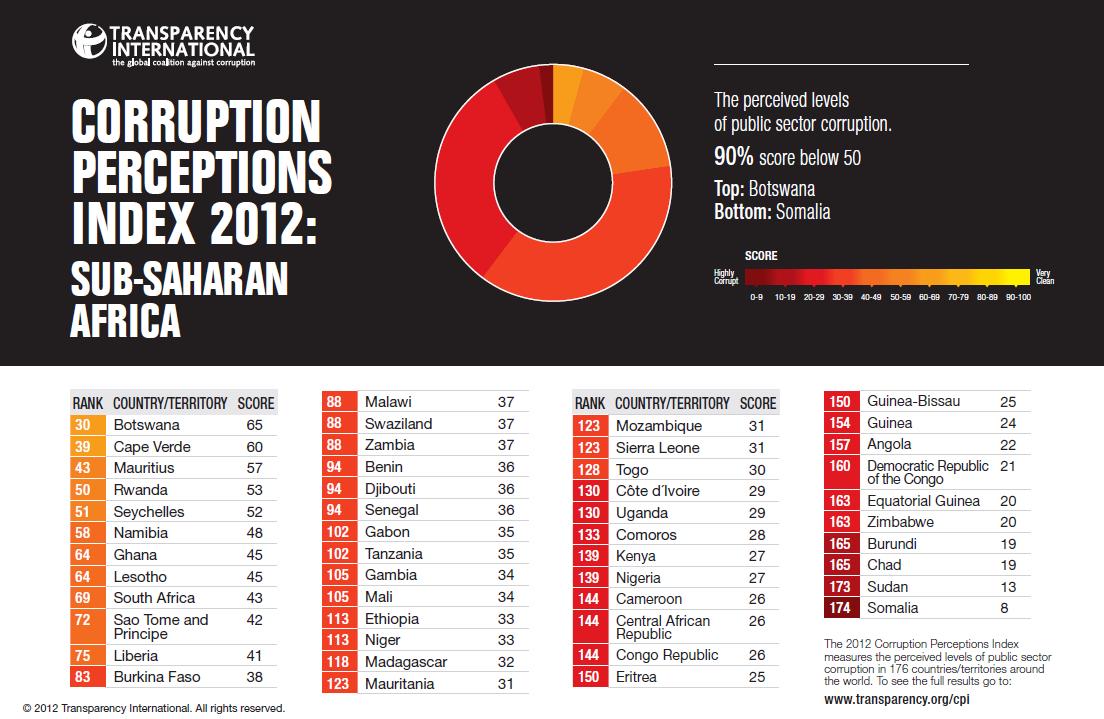
75 million Africans Paid A bribe in 2014

A majority of Africans say corruption has risen in the past 12 months and most governments are seen as failing in their duty to stop the abuse of power, bribery and secret deals, according to a new opinion poll from Transparency International (http://www.Transparency.org).
In the report People and Corruption: Africa Survey 2015, part of the Global Corruption Barometer, Transparency International partnered with Afrobarometer, which spoke to 43,143 respondents across 28 countries in Sub-Saharan Africa between March 2014 and September 2015 to ask them about their experiences and perceptions of corruption in their country.

The majority (58 per cent) of Africans in the surveyed countries, say corruption has increased over the past 12 months. In 18 out of 28 countries surveyed a large majority of people said their government is doing badly at fighting corruption.
Despite these disappointing findings, the bright spots across the continent were in Botswana, Burkina Faso, Lesotho and Senegal. Citizens in these countries were some of the most positive in the region when discussing corruption.
For the first time, people reported business executives as highly corrupt. Business ranked as having the second highest levels of corruption in the region, just below the police. The police regularly rate as highly corrupt, but the strongly negative assessment of business executives is new compared to previous surveys.
Many Africans, particularly the poor, are burdened by corruption when trying to get access to key basic services in their country. 22 per cent of people that have come into contact with a public service in the past 12 months paid a bribe.
Of the six key public services that we asked about, people who come into contact with the courts and police are the most likely to have paid a bribe. 28 per cent and 27 per cent respectively of people who had contact with these services paid a bribe. Across the continent, poor people who use public services are twice as likely as rich people to have paid a bribe, and in urban areas they are even more likely to pay bribes.
“Corruption creates and increases poverty and exclusion. While corrupt individuals with political power enjoy a lavish life, millions of Africans are deprived of their basic needs like food, health, education, housing, access to clean water and sanitation. We call on governments and judges to stop corruption, eradicate impunity and implement Goal 16 of the Sustainable Development Goals to curb corruption. We also call on the people to demand honesty and transparency, and mobilize against corruption. It is time to say enough and unmask the corrupt,” said Transparency International Chair José Ugaz.
It is increasingly clear that citizens are a key part of any anti-corruption initiative. However, the survey finds that corruption reporting mechanisms are often seen as too dangerous, ineffective or unclear. More than 1 out of 3 Africans thinks that a whistleblower faces negative consequences for reporting corruption, which is why most people don’t report.
“Our work as civil society is clear: we have to spread a message of hope across the continent. Corruption can be tackled. People need to be given the space to stand up against it without fear of retaliation and governments need to get serious about ending the widespread impunity.”
Transparency International recommends:
– Governments strengthen and enforce legislation on corrupt business people and anti-money laundering to curb the high volume of illicit flows from the continent. This could address the negative perception of business if those profiting are held to account.
– Governments establish right to information and whistle-blower protection legislation to facilitate the role of civil society in making public institutions more transparent, accountable and corruption-free.
– Governments show a sustained and deep commitment to acting on police corruption at all levels by promoting reforms that combine punitive measures with structural changes over the short- and medium-term. Cracking down on petty bribery has direct impact on the most vulnerable in society.
– The African Union and its members provide the political will and financing needed to implement the review mechanism established for its anti-corruption convention.
Unless it’s stopped, corruption slows development and economic growth while weakening people’s trust in government and the accountability of public institutions.
Posted by Ike Onwubuya